Pay Attention! Give Attention.
How Attention Shapes Who We Are Becoming
By Amy Shortt | November 2026
In this Calvin and Hobbes strip, Calvin creeps up behind his father, who is lost in a book, blows up a paper bag, and pops it right behind his chair. When his dad finally comes back down to earth, Calvin says simply, “Pay attention to me.”
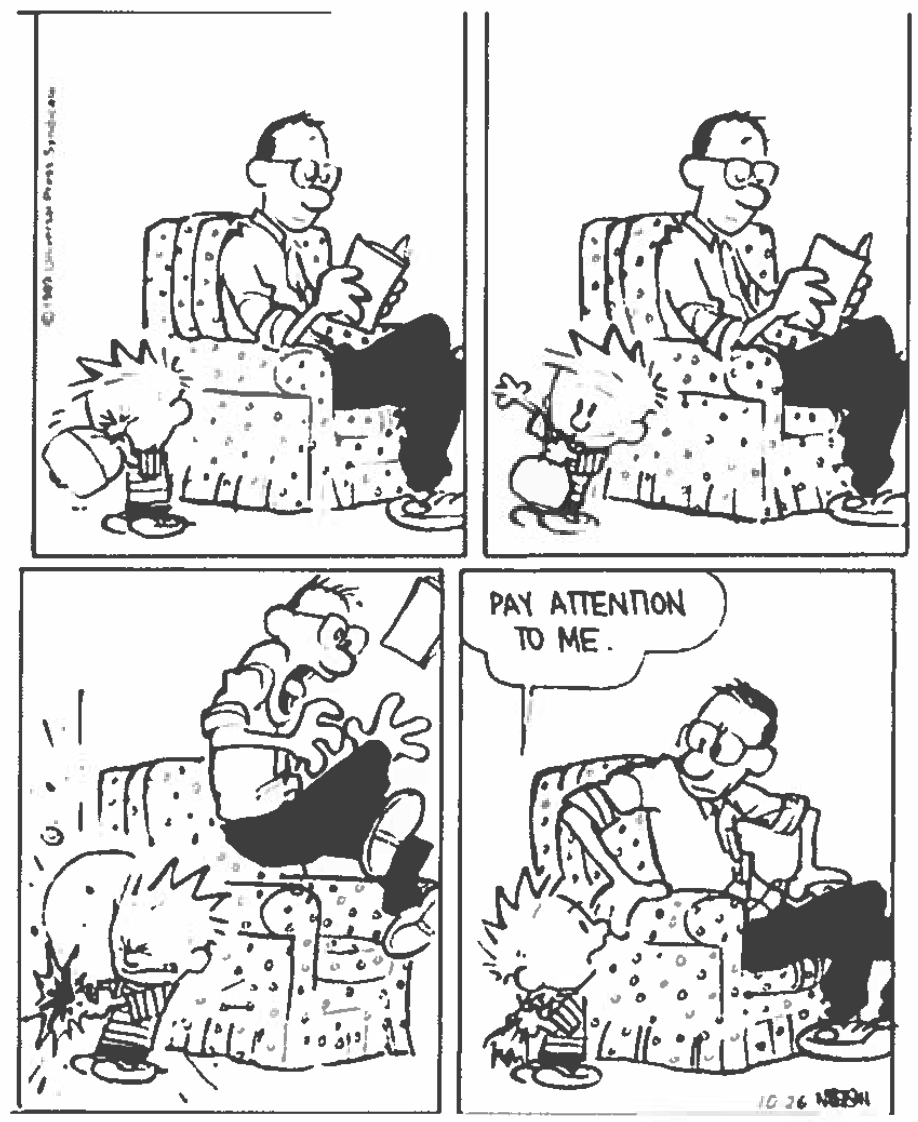
We laugh, because we know the feeling. Most of us aren’t quite that dramatic, but underneath so much of our noise is the same longing: to be noticed, to be seen.
Being the one who’s supposed to pay attention is another matter entirely. Once, during a long meeting, I received a text from a friend, to which I replied, “Can’t text. In meeting. Playing attention.” The autocorrect was, this time, actually correct. I was playing attention. It became a running joke between us, our code for being there but not there.
And while we laughed about it, it made me curious. Why do we say we pay attention? Why that word?
Languages offer different ways of speaking about attention. In English, we pay attention, as though it were owed or an obligation. In Spanish, we lend attention, prestar atención, as though it will come back. In French, we pay attention too, faire attention, a phrase that can also mean to take care. And in German, we can give attention as a gift: Aufmerksamkeit schenken. These expressions are not complete accounts of how different cultures understand attention, but they invite us to hear a familiar word differently.
Perhaps the Germans are onto something. Attention is a gift, one that can enrich both the giver and the receiver. But not everything we attend to is worthy of that gift. What we repeatedly give our attention to shapes who we are becoming. When we direct it toward what is good, true, and beautiful, attention becomes a gift to ourselves as well. And it is a gift to others, perhaps one of the most loving things we can offer another person: to look at them fully, patiently, and truly see them.
The word attention comes from the Latin attendere: ad, “toward,” and tendere, “to stretch.” To attend to something is to stretch toward it, to reach the whole self in its direction.
The same root runs through some of our most important words. To intend is to direct ourselves toward a purpose. To tend a garden, a child, or a wound is to remain turned toward it over time, with care. Attention, intention, and tending are related words, and each suggests a movement toward what matters.
That paints a very different picture than paying attention. A payment is transactional. We hand it over and we’re done. But stretching toward something changes the one who is stretching. A musician knows this. Attend deeply to a Brahms intermezzo, and something can begin to change: the breath slows, the body quiets, something in us leans forward to meet it.
The psychiatrist and philosopher Iain McGilchrist has spent decades exploring how the way we attend shapes the world we perceive. He describes two fundamentally different ways of attending to the world. One is narrow and focused. It grasps, isolates, categorizes, and uses. It’s the attention of someone following their phone’s map so closely that they miss the city around them. The other is broad, open, and sustained. It receives things whole, in their context and their relationships. It’s the attention that lets us see a face, hear a melody, or sense what isn’t being said in a room.
We need both kinds of attention. Focused attention helps us examine, distinguish, and act. Broader attention helps us perceive context, relationship, and meaning. The trouble begins when one way of attending becomes the only way we know how to see. McGilchrist argues that our culture favors a narrow, task-oriented way of attending to the world, one that emphasizes analysis, utility, and control. Attention is not neutral: the way we attend changes what we find. He calls attention a moral act. A forest can be seen merely as a supply of lumber, its value measured in what can be extracted from it. Or it can be encountered as a living ecosystem, an intricate community of trees, plants, animals, and relationships to which we ourselves belong. A colleague can appear as a function to manage or as a person of inherent dignity and worth.
When I’m playing attention, I’m not entirely absent. I catch the fragments I need: the gist of a story, the answer to a question, the next thing on my list. What I miss is everything else: the hesitation in a friend’s voice, the feeling underneath the words, the person right in front of me.
Scrolling works the same way, only faster. The eyes glance, the thumb moves, and the mind skims across a stream of headlines, faces, and opinions, taking a little from each and truly receiving none of them. The technology writer Linda Stone named this “continuous partial attention.” We’re always a little bit engaged and never fully present. It feels like attention. It even looks like attention. But nothing is truly given, and nothing is truly received.
In McGilchrist’s terms, this can resemble the narrow, grasping mode left running all day long. And because attention is formative, that matters more than we might think. What we practice, we become, and attention is no exception. I wonder what happens to our capacity for depth when so much of our attention is spent skimming and scrolling. Do we gradually lose some of our ability to stay with what is difficult, to sit with another person in pain, or to hear the long arc of a piece of music?
This is why the direction of our attention matters. Each time we choose what to stretch toward, we’re casting a small vote for the person we’re becoming. When our attention is scattered, so are our lives and our leadership. But when we practice deep, patient attention toward what is worthy, we bring that depth into every conversation, every decision, every room.
Attention is also a gift we give to others. The philosopher and novelist Iris Murdoch tells a story about a mother-in-law, whom she calls M, who finds her son’s new wife, D, rather tiresome. D seems unrefined, a little too familiar, juvenile. M is a proper woman, and she never lets any of this show. Her behavior toward D is perfectly kind.
But over time, M decides to look again. She asks herself whether she’s being fair, whether her own snobbery or jealousy might be clouding her view. She keeps looking, patiently and honestly. And gradually, D comes into focus differently. What once seemed unrefined now seems refreshingly simple. What seemed juvenile now seems delightfully young.
Nothing outward has changed. D is the same person. M’s actions are the same. She was already behaving kindly; what changes is something deeper. She begins to see another person more truthfully. Her transformation is not simply behavioral. It is a transformation of character, brought about through the quality of her attention. Murdoch calls this a “just and loving gaze,” and she believed it was at the heart of the moral life. We may act kindly before we see someone rightly. But learning to see them justly and lovingly changes the spirit in which we act.
Simone Weil put it even more simply: attention is the rarest and purest form of generosity.
I think we know this instinctively. Think of the people who have most shaped your life. A teacher, a mentor, a friend. Chances are, what you remember most is not what they told you, but how it felt to be fully seen by them. To sit across from someone who wasn’t checking the clock or waiting for their turn to talk, who was simply, wholly there. Being truly attended to is one of the most powerful experiences a person can have. It tells us, without words, that we matter.
For leaders, this may be the most important gift of all. People grow when they are seen. A leader who offers a just and loving gaze, who looks again, who sees past the label and the performance review to the person, creates the conditions for others to become who they are meant to be.
So where does this leave us, those of us who sit through the meetings and carry the phones and live in a world designed to capture our attention rather than receive it?
I don’t think the answer is guilt. Some days I like to play attention. A little daydreaming in a long meeting can be its own small rest, and a wandering mind is sometimes where new ideas surface. But I’ve started to notice the moments when I have a choice, and to ask a different question in them. Not “Am I paying attention?” but “What am I giving my attention to, and how is it shaping who I am becoming?”
But attention alone is not enough. We can give our attention to what diminishes us as readily as to what enlarges us. If what we attend to helps shape who we become, then choosing what deserves our attention becomes a question of character. If attention forms us, then why not stretch toward beauty? By beauty, I don’t mean prettiness, the polished and the pleasant. I mean beauty in its older, deeper sense: whatever is good, whatever is true, whatever calls us out of ourselves.
The apostle Paul offered the same counsel:
Whatsoever things are true, whatsoever things are honest, whatsoever things are just, whatsoever things are pure, whatsoever things are lovely, whatsoever things are of good report; if there be any virtue, and if there be any praise, think on these things. (Philippians 4:8)
It’s an ancient description of intentional attention, and an invitation to be formed by what is worthy of us.
When we intentionally give our attention to what is beautiful, good, just, and true, we open ourselves to being formed toward wisdom. And wisdom, at its best, is oriented toward love—not merely sentiment, but a commitment to the flourishing of others and the common good. Sometimes that loving attention also asks us to face what is painful or unjust, rather than look away. And when we give our attention fully to another person, we offer one of the most loving things one human can give another: the experience of being truly seen.
So this week, I invite you to try two small practices. First, choose one conversation and give the other person your full attention. No skimming, no scanning, no playing attention while rehearsing what you’ll say next. Simply be present with that person, in that moment, and listen without needing to respond immediately. Second, choose one thing of beauty*—a piece of music, a poem, or the night sky—and simply stay with it. Resist the urge to explain or evaluate it. Notice what draws your attention, what surprises you, and what begins to unfold as you linger. Consider what the encounter reveals and how it might shape who you are becoming.
It is wise to give attention to what we pay—or play—attention to. And wisdom grows when we learn to look again, with a just and loving gaze, at the world, at one another, and at who we are becoming.
*See “Think on These Things: Suggested Encounters with Beauty” below.
Think on These Things: Suggested Encounters with Beauty — Music and Poetry
Intermezzo in A major, Op. 118, No. 2 – Johannes Brahms
Find a quiet place, and let this be the only thing you do for these few minutes. As the opening melody begins, notice how it seems to lean and sigh, as if reaching toward something. When the music turns darker and more restless in the middle, notice what stirs in you, and stay with it rather than drifting away. When the opening melody returns, listen for whether it sounds different now that you have traveled with it. When the last note fades, sit in the silence a moment longer before reaching for anything else.
Watch Anna Dmytrenko perform BrahmsSure on This Shining Night by Morten Laurdisen (poetry by James Agee)
Begin by reading James Agee’s poem slowly. Then listen to Lauridsen’s setting, performed by the Westminster Choir of Westminster Choir College at Rider University, recorded at the Choral Institute at Oxford in July 2022. Notice how the music gives new expression to the words, how the harmonies move, and where the voices seem to breathe. When the final sound fades, remain in the silence for a moment.
Sure on this shining night
Of star made shadows round,
Kindness must watch for me
This side the ground.
The late year lies down the north.
All is healed, all is health.
High summer holds the earth.
Hearts all whole.
Sure on this shining night I weep for wonder wand'ring far
alone
Of shadows on the stars.
The poem comes from a book by James Agee entitled "Permit Me Voyage" published 1934 by Yale University Press
© by owner. provided at no charge for educational purposes
The Sweetness of Dogs by Mary Oliver
Read Oliver’s poem slowly. Notice where her attention rests and how Percy’s loving gaze offers another way of seeing. What might this encounter reveal about attention, beauty, and love?
The Sweetness of Dogs by Mary Oliver
What do you say, Percy? I am thinking
of sitting out on the sand to watch
the moon rise. It’s full tonight.
So we go
and the moon rises, so beautiful it
makes me shudder, makes me think about
time and space, makes me take
measure of myself: one iota
pondering heaven. Thus we sit, myself
thinking how grateful I am for the moon’s
perfect beauty and also, oh! how rich
it is to love the world. Percy, meanwhile,
leans against me and gazes up
into my face. As though I were just as wonderful
as the perfect moon.

Sources
Bill Watterson, Calvin and Hobbes, October 26, 1989. © Bill Watterson. Distributed by Andrews McMeel Syndication.
Iain McGilchrist, The Master and His Emissary: The Divided Brain and the Making of the Western World (Yale University Press, 2009); The Matter with Things: Our Brains, Our Delusions, and the Unmaking of the World (Perspectiva Press, 2021).
Linda Stone coined the phrase “continuous partial attention” in 1998.
Iris Murdoch, The Sovereignty of Good (Routledge & Kegan Paul, 1970). The story of M and D, and the “just and loving gaze,” appear in the essay “The Idea of Perfection”; the kestrel and “unselfing” appear in “The Sovereignty of Good Over Other Concepts.”
Simone Weil, letter to Joë Bousquet, April 13, 1942; English wording also quoted in Simone Pétrement, Simone Weil: A Life (1976), translated by Raymond Rosenthal.
Philippians 4:8, King James Version.
Mary Oliver, “The Sweetness of Dogs,” in Dog Songs (Penguin Press, 2013).
James Agee, “Description of Elysium,” in Permit Me Voyage (Yale University Press, 1934); set by Morten Lauridsen as “Sure on This Shining Night” in Nocturnes.
Etymologies of attention, intend, and tend: Online Etymology Dictionary (etymonline.com).
Johannes Brahms, Intermezzo in A major, Op. 118, No. 2. Performance: Anna Dmytrenko, https://youtu.be/doSSutlNfXI.
Morten Lauridsen, “Sure on This Shining Night.” Performance: Westminster Choir, Choral Institute at Oxford, July 2022, https://www.youtube.com/watch?v=kK6mtPHV1gI.